
BirdNET-Analyzer
BirdNET-Analyzer is the workhorse tool for large-scale animal sound analysis, built for scientific workflows and long-term acoustic monitoring.
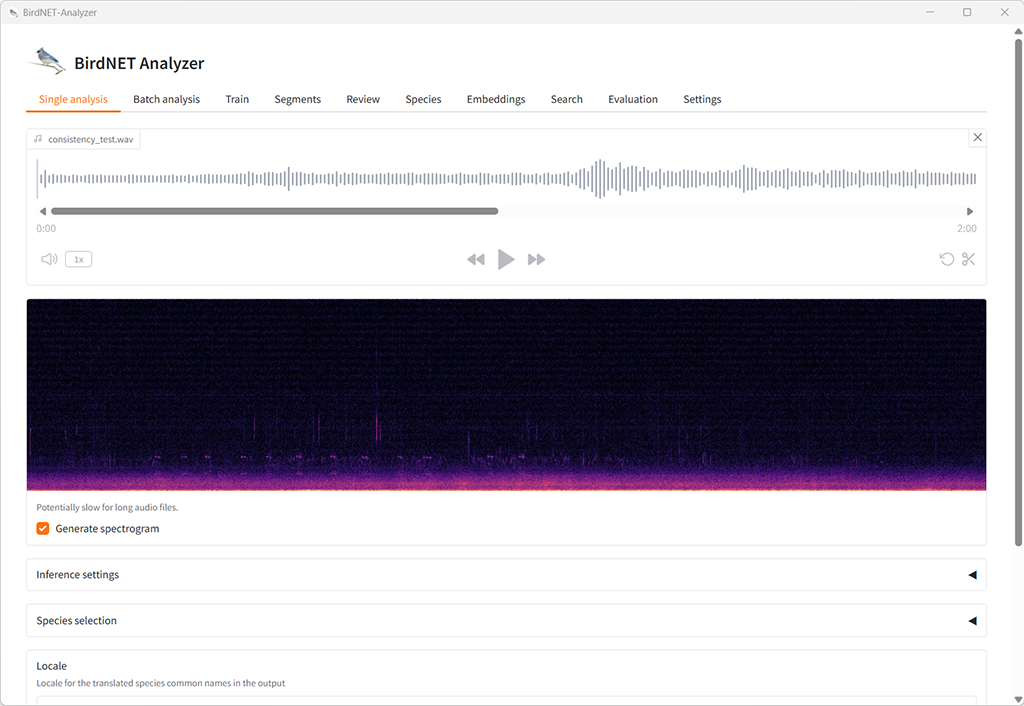
Built for scale.
BirdNET-Analyzer applies state-of-the-art deep learning models to your audio recordings, transforming thousands of hours of sound into structured ecological data.
Advanced capabilities.
High Throughput Pipelines
Process massive datasets using the CLI with multithreading and batch support. Host your own analysis API with the integrated server for distributed workflows.
Custom Model Training
Train custom classifiers on top of BirdNET embeddings to identify new species or sounds. Supports append/replace modes and automatic hyperparameter tuning.
Embeddings & Similarity
Extract high-dimensional feature vectors (embeddings) to search for similar sounds, perform clustering, or identify acoustic patterns in unlabeled data.
Performance Evaluation
Assess model accuracy using ground-truth annotations. Compute detailed metrics including F1, Precision, Recall, AUROC, and Confusion Matrices.
Segment Review Tool
Extract species-specific audio clips (segments) for manual validation. Use the Review Tab to systematically confirm detections and exported labeled data.
Developer Tooling
Extensive command-line interface and Python module support for seamless integration into custom R or Python research pipelines.
Scientific Workflow
BirdNET-Analyzer provides a complete end-to-end framework for bioacoustic research, from raw data to validated ecological insights.
Precision at Scale
Leverage multithreaded CLI analysis to process terabytes of data. Use the --batch_size argument to optimize for your CPU or GPU hardware.
Adaptive Learning
Train classifiers using "Append" mode to add unique local species without losing the 6,000+ base species already in BirdNET.
Intelligent Filtering
Utilize the species range model (eBird-data powered) to automatically filter detections based on latitude, longitude, and week of the year.
Embeddings Search
Generate sqlite-based scalar databases of 1024-dimensional feature vectors for rapid query-by-example sound searching.
Get involved.
Issues & Feedback
Found a bug or have a feature request? Our GitHub tracker is the best place to report issues. Please include your OS and Python version.
Code Contributions
We welcome pull requests for performance optimizations, new features, or documentation improvements. Check out our contribution guide.
Discussions
Have questions about analysis parameters or want to share your workflow? Join the conversation on GitHub Discussions.
Reddit Community
Connect with other BirdNET users, share your backyard monitoring setups, and troubleshoot with the community on r/BirdNET_Analyzer.
Found a security issue?
Please do not open a public issue for security-related items. Email the maintainers directly via the contact information provided in the repository's README.
Help us improve BirdNET-Analyzer
BirdNET-Analyzer is an open-source project. Your code contributions, bug reports, and data help us make it better for everyone.